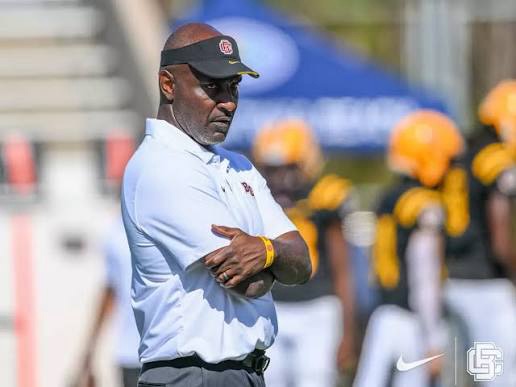
Three weeks ago, Bethune-Cookman was in the thick of the SWAC East race, with first place and a potential path to the Celebration Bowl still within reach. Today, the university announced that it is moving on from Head Coach Raymond Woodie Jr.
That’s how quickly things can change in college football.
The announcement Sunday brings an end to Woodie’s four-season tenure as the 16th head football coach in Bethune-Cookman history. Legendary former Wildcat coach Alvin “Shine” Wyatt will take over on an interim basis, beginning with next Saturday’s Florida Blue Florida Classic.
Woodie’s departure is disappointing, but it deserves a little more context than simply looking at the final record and declaring the experiment a failure.
When Woodie returned to his alma mater in February 2023, he inherited a football program that was dealing with challenges extending well beyond the football field.
Bethune-Cookman was still trying to find its footing after one of the most turbulent periods in the university’s history. The institution’s financial and accreditation struggles, including its probationary status with the Southern Association of Colleges and Schools Commission on Colleges (SACSCOC), had threatened its very existence.
At one point, the university’s leadership publicly warned that the institution’s future depended on getting its financial house in order. The consequences reached virtually every corner of campus. Academic programs, staffing, resources and athletics all felt the impact of the university’s crisis. Athletic programs were eliminated, and the future of the department itself was uncertain.
Woodie didn’t walk into a traditional rebuilding situation. He was inheriting a program that needed to be stabilized while the university worked to stabilize itself.
And to his credit, there were some important accomplishments along the way.
STABILIZING MORE THAN THE FOOTBALL PROGRAM
Woodie brought an impressive resume back to Daytona. The former two-time FCS All-American linebacker at BCU spent time coaching at Oregon, Florida State, South Florida, Western Kentucky, and Florida Atlantic. His recruiting experience and relationships across the state were expected to help the Wildcats regain their footing.
His first two seasons were difficult on the scoreboard.
BCU went 3-8 in 2023 and followed that with a disappointing 2-10 campaign in 2024. But there were other measures of progress that deserve recognition.
One of the more significant accomplishments came in the classroom.
During the program’s first full season under Woodie, Bethune-Cookman’s Academic Progress Rate (APR) increased by 91 points. The football team’s cumulative GPA reportedly climbed from 2.4 to 3.25. Of the 120 players in the program, 19 earned a place on the President’s List with a 4.0 GPA.
Those aren’t insignificant accomplishments for a program coming through such a difficult institutional transition.
The improvement reflected a greater emphasis on academic accountability and the responsibility of representing the university beyond the football field.
By 2025, the program appeared to be making progress.
The Wildcats finished 6-6 overall and 5-3 in conference play, good for third place in the SWAC East. The offense ranked fourth in the conference in total offense and offensive efficiency, while the defense finished second in sacks.
There were legitimate reasons for optimism.
For the first time in Woodie’s tenure, BCU had a winning conference record and appeared to be building toward something more substantial.
THE WOODIE ERA BY THE NUMBERS
The year-by-year results tells the story.
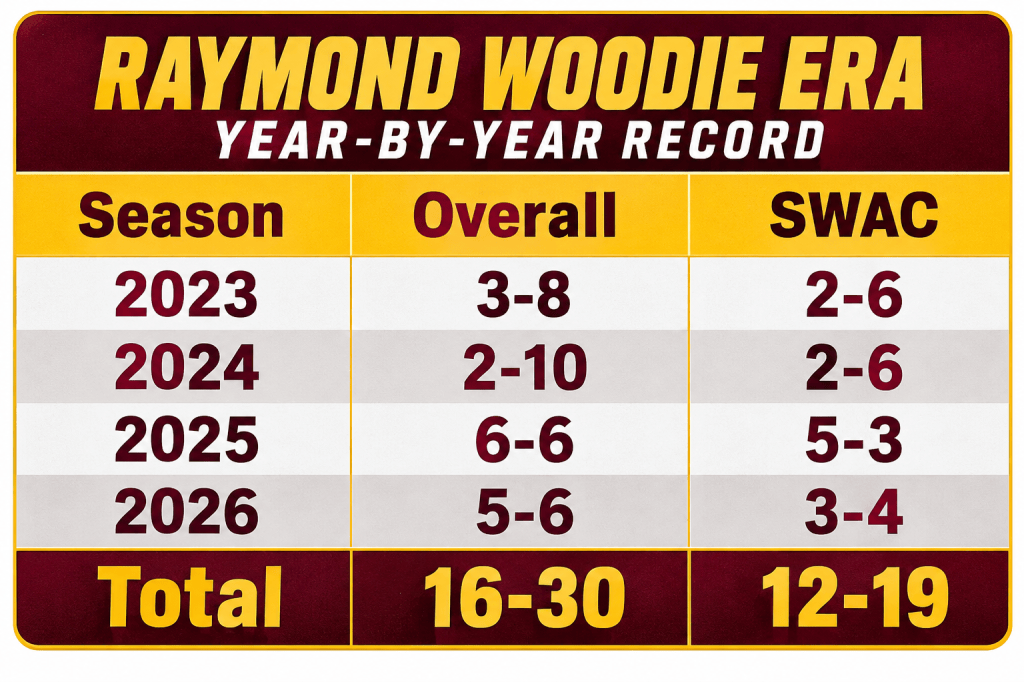
Records through the November 14 Grambling game.
The 2025 season was clearly the high point. Unfortunately, the Wildcats couldn’t sustain that momentum.
WHEN THE BOTTOM FELL OUT
The 2026 season started with some familiar concerns.
A 73-6 opening night loss to UCF was an unfortunate reminder of the gap between FCS schools and the resources available to Power Four programs. But the Wildcats responded with victories over Stetson (43-18) and Virginia-Lynchburg (62-3).
There was reason to believe the team could put together a competitive season.
A 31-21 loss to South Carolina State followed, but BCU responded by defeating Alabama State 16-10. That victory was particularly encouraging, giving the Wildcats a 3-2 overall record and a 1-0 start in SWAC play.
Then came the 55-17 loss at Alabama A&M.
The Wildcats bounced back with victories over Mississippi Valley State (34-14) and Jackson State (24-21). The defense held the Tigers to just 33 rushing yards on 36 attempts, and the Wildcats improved to 5-3 overall and 3-1 in conference play.
At that point, the SWAC East race was very much alive.
First place was within reach. A Celebration Bowl appearance was still a possibility.
Three weeks later, the conversation had changed entirely.
The Wildcats proceeded to lose four consecutive conference games, and not all losses were created equal.
The margin of defeat became increasingly difficult to ignore:
- Alabama A&M: 55-17 — 38-point defeat.
- Arkansas-Pine Bluff: 63-21 — 42-point defeat.
- Southern: 45-17 — 28-point defeat.
- Grambling: 32-21 — 11-point defeat.
After demonstrating the ability to compete with SCSU and defeat Alabama State and JSU, the Wildcats were unable to sustain that level of performance. The losses to Alabama A&M, Arkansas-Pine Bluff and Southern were particularly damaging.
They raised questions about the team’s consistency, preparation, competitive toughness and ability to respond when things went wrong.
The four game conference slide ultimately proved too much to overcome.
THE EXPECTATIONS NEVER CHANGED
Perhaps that’s the most important part of this discussion.
BCU isn’t a program without a football tradition. It has championship history, an established alumni network, a rich recruiting footprint and a fan base that remembers when the Wildcats were a perennial contender.
The college football landscape may have changed but the expectations associated with the Bethune-Cookman name never disappeared.
Woodie helped stabilize the program during a difficult period. He improved the academic standing of the football program and brought the Wildcats back into the conversation in 2025.
But ultimately, the university wanted more.
In its announcement, the university made clear that its expectations remain high and that its objective is to build a program capable of competing consistently at the top of the SWAC.
That is the standard the next head coach will inherit.
For Raymond Woodie, the opportunity to lead his alma mater has come to an end. His tenure will be remembered for some meaningful contributions to a program that needed them, but also for the inability to translate incremental progress into sustained success on the football field.
And now, the timing couldn’t be more interesting.
With the Florida Classic just six days away, BCU has turned to one of the most recognizable figures in its football history.
Shine Wyatt is back.
There will be time to debate the next head coaching hire, evaluate the roster and examine the direction of the program.
For now, the Wildcats have one more game to play, one more rivalry to settle and an opportunity to finish the season on a high note.
Raymond Woodie’s chapter is closed.
The next chapter of Bethune-Cookman football begins with a familiar face and a very familiar assignment.
Beat FAMU.

